Fourteen daysto a dog whodoesn't run.
This is the card that ships in every box. It's also just here, in full, because a plan that only works if you bought something isn't a plan — it's an ad.
Before you start, three things.
Sessions are 60 seconds. Set a timer. The most common failure is a good session going on too long and ending badly, which teaches the exact opposite of what you wanted.
Use food your dog doesn't otherwise get. Chicken, cheese, hot dog. Kibble is not payment.
End every session while the dog still wants more. Every one. Even the good ones. Especially the good ones.
The premise: your dog isn't afraid of nail trims. He's afraid of a specific sequence — you approach, a paw gets held, something happens he can't predict. Take the sequence apart and there's nothing left to be afraid of.
Nine of the fourteen daysdon't involve a nail.
Printed on a card for your fridge, in the box with every order.
 DAYS 1–3
The hum means chicken
Switch the grinder on across the room. Feed. Switch it off, stop feeding. Do that four or five times and put it away. Total elapsed time: about a minute.
You are building one association and only one: that sound predicts food. If your dog leaves the room, you're too close — go further away and try again tomorrow. If he stares at your hand waiting, that's the whole thing working.
Signal you're ready to move on: the dog looks at you expectantly when the tool switches on, instead of looking at the tool.
 DAYS 4–7
Paws stop meaning anything
Tool off and out of sight. Touch a paw for one second, feed, let go. Build to three seconds of a paw actually held in your palm. When that's boring, do it again with the grinder running in your other hand, across your body, not near the paw.
If the paw gets pulled back, you went too fast — you don't correct it, you just go back to one second tomorrow. Nothing is lost. This part is not a test.
Signal: your dog offers the paw, or at minimum leaves it in your hand while looking somewhere else entirely.
 DAYS 8–11
One nail, then away
Front dewclaw first — it's the easiest to reach and the least defended. One short pass, under two seconds. Feed. Then put the tool away, even if it went perfectly.
This is the day everyone ruins. The dog is fine, so you do a second nail, then a third, then the dog has had enough, and the session ends on a struggle. That struggle is what gets remembered. Stopping early is not caution — it's the active ingredient.
Signal: the dog stays put through a pass without bracing.
 DAY 12 ONWARD
One paw a sitting, forever
Four nails, praise, done. Four paws across a week. That's the maintenance pattern and most people never go back to doing all sixteen at once — not because they can't, but because there's no reason to.
Once a week keeps the quick receding, which is the actual long game: the shorter the quick, the shorter you can take the nail, the less often any of this is a problem.
Signal: you stop dreading it. That's the one that counts.
Where to stop,on either colour.
Light nails let you see the quick straight through the shell. Dark ones don't, so you read the cut face instead: chalky white ring, then a small dark dot in the middle of it.
The dot is the leading edge of the quick. That's your stop sign, and it's the one thing a clipper can never show you in time.
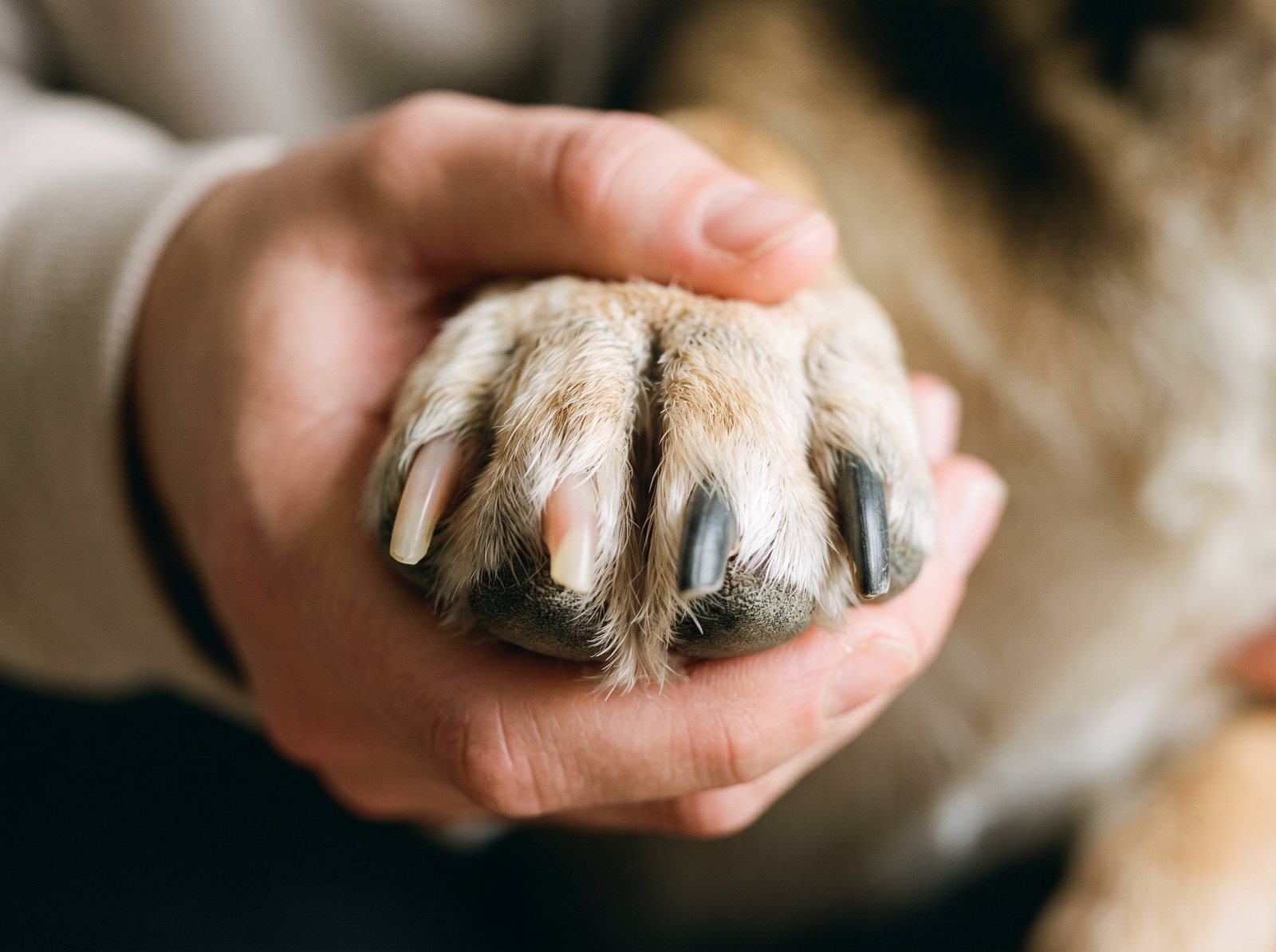
What you are looking at, pass by pass
-
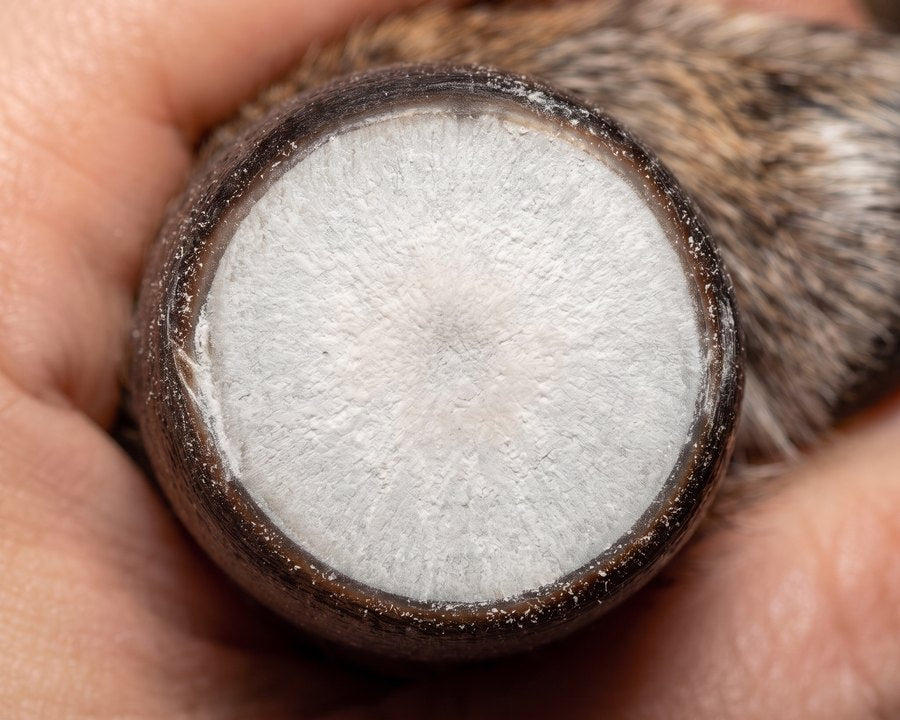 01Keep going
Chalky white ring
Dry, dusty, uniform. There is nothing underneath it yet. Keep going.
-
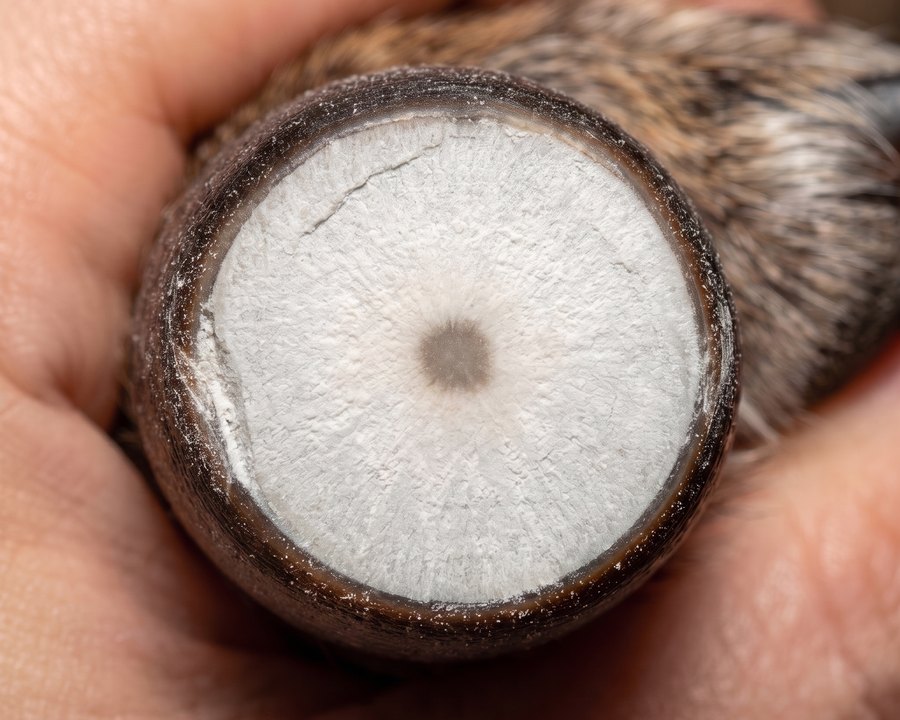 02Slow down
A dark dot appears
A small grey-brown circle in the dead centre. This is the leading edge of the quick.
-
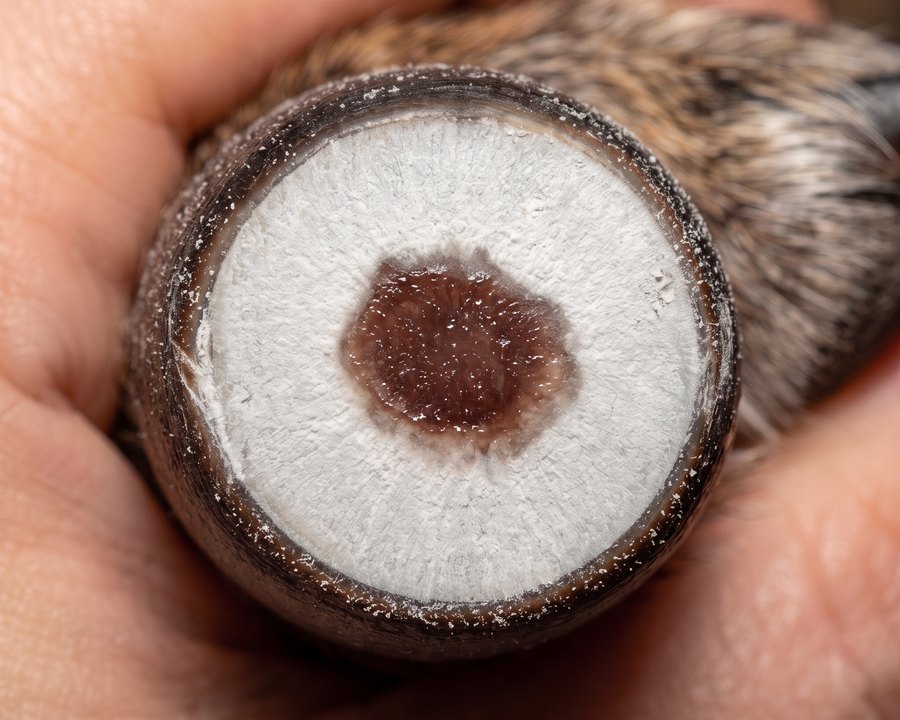 03Stop
Stop here
The dot has definition and colour. One more pass reaches blood. Put the tool down.
When this plan is the wrong tool
- If your dog has ever bitten, or air-snapped, over a paw — stop and book a vet or a qualified behaviourist. A fourteen-day home protocol is not the right intervention for a bite history and we're not going to pretend otherwise.
- If the nails are already so long the quick has grown out with them, you may need a vet or groomer to take the first pass under sedation. After that this plan works fine.
- If a nail is split, cracked or has any discharge — vet, not grinder.
None of this is veterinary advice. It's a handling protocol, and it assumes a healthy dog with an ordinary aversion.
Run it with whateveryou already own.
Genuinely. The plan does most of the work. If you'd rather start from a tool that hums quietly and has this card in the box, that's what we sell.
60 days, our return postage.